























How Does Home Advantage Affect Football Match Performance?
This article examines how home advantage affects football match performance — the numbers behind it, the mechanisms that produce it, how it varies across leagues and eras, and what it means for analysis, coaching, and prediction.

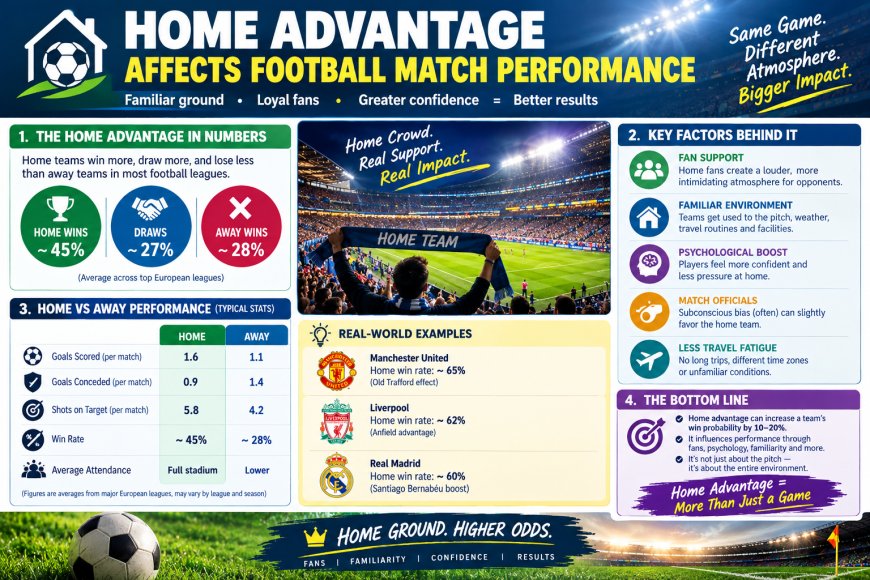
Walk into any football stadium on a matchday and the truth of home advantage is visceral: the roar when the home side wins a corner, the groan at a refereeing decision against the visitors, the comfort of a team playing on a pitch it knows by heart. But beneath the atmosphere sits a century of research asking a deceptively simple question — does playing at home genuinely improve performance, and if so, why? The answer, supported by thousands of matches across leagues and continents, is a qualified yes: home advantage is real, measurable, and historically significant, though its size has evolved and its causes remain debated.
This article examines how home advantage affects football match performance — the numbers behind it, the mechanisms that produce it, how it varies across leagues and eras, and what it means for analysis, coaching, and prediction.
1. The Evidence: Home Advantage in Numbers
Home advantage is typically measured in two ways: the percentage of matches won by home teams, or the share of available points taken by home sides. Both metrics have been studied extensively.
· Long-run home win rates in professional football generally fall between 46% and 60%, depending on the league and era — comfortably above the ~33% expected if draws split evenly and home/away wins were balanced.
· Points-share analysis dating back to foundational studies (Pollard, 1986) found English league home sides historically winning around 64% of all available points — teams playing at home won roughly 75% more points than away sides in the classic era.
· Cross-sport meta-analyses (Courneya & Carron, 1992; Jamieson) report overall home winning percentages near 60%, with football showing among the strongest home effects of major team sports — higher, for example, than American football (~57%).
· UEFA Champions League data (2021–2024) shows home teams winning approximately 61% of matches, alongside better numbers in goals, shots on target, possession in the opposition half, and touches in the opponent's box.
· Modern Premier League-era data from Sky Sports found home win percentages near 49% across a studied recent season, with home advantage increasing a team's likelihood of winning by around 15.9% in the top flight — an effect that weakened progressively down the English football pyramid (Championship ~14%, League One ~12%, League Two ~7% in the same analysis).
The overall picture: home advantage has always existed, but it is not static. English home win rates peaked historically at 64.6% in 1895/96 and hit record lows around 41% in 2015/16 across all four professional tiers — evidence that the phenomenon responds to changing football conditions rather than being a fixed law of nature. Home advantage in football can be influenced by crowd support, familiarity with the stadium, travel conditions, and the team's comfort playing in familiar surroundings. Follow football and sports action with Mahadev Book.
2. Why Does Home Advantage Exist? The Main Explanations
Researchers have proposed four principal mechanisms, each supported by different strands of evidence.
a) Crowd Support
The most intuitive factor — and one of the most studied. Larger, louder crowds correlate with stronger home effects. Research cited across football studies links crowd presence to advantages as high as 12% over opponents, and crowd noise has been associated with refereeing outcomes, with some studies reporting up to 15.5% fewer fouls called against the home side when crowds are large.
The COVID-19 pandemic provided a natural experiment: behind-closed-doors matches across Europe showed reduced (though not always eliminated) home advantages. In the NBA, similar research found home teams won by roughly 2.2 more games per season with fans present than without — and estimated that the mere presence of home fans explains a larger share of home advantage than previously thought. Football's empty-stadium experiments showed comparable directional effects, particularly in leagues where crowd intensity is extreme.
Crowds influence performance through arousal and motivation (home players effort-increase), opponent anxiety, and referee psychology — conscious or unconscious.
b) Travel and Environment
Away teams travel — sometimes across countries and time zones — disrupting sleep, routine, and preparation. Home teams sleep in their own beds, train on familiar schedules, and eat normal meals. While modern sport has minimised some travel costs (private jets, hotel routines), research continues to find small but consistent fatigue effects, particularly for midweek away fixtures stacked before weekend games.
Environmental familiarity extends beyond travel: home players know the pitch dimensions, grass length, wind patterns, altitude, and even the bounce of a particular surface. Visiting teams adjust during warm-ups, but adjustment is not equivalence.
c) Refereeing and Decision-Making
Do referees favour home teams? The evidence is nuanced. Studies have found small home-biased patterns in foul calls, penalty awards, and card distributions — often amplified by crowd noise at decisive moments. However, newer causal analyses of the Premier League (arXiv, 2022–2025) found little evidence of direct referee bias across venues in their models, suggesting much of the "bias" may operate indirectly through player behaviour (home players pressing more, winning more fouls in dangerous areas) rather than blatant officiating partiality.
Either way, the behavioural pathway exists: home teams that play higher up the pitch and attack more win more free-kicks in useful zones — a form of advantage rooted in initiative rather than officiating gifts.
d) Psychological and Strategic Factors
Home teams typically adopt more attacking, proactive styles — higher defensive lines, more possession in the opposition half, more shots. The Champions League analyses confirm home superiority in offensive organisation metrics (possession, box entries, key passes) alongside goal outcomes. Confidence, perceived control, and crowd energy combine to produce bolder decisions: attempting riskier passes, pressing higher, committing more players forward.
Away teams, conversely, often adopt conservative game plans — deeper blocks, counter-attacking focus — which can neutralise home quality but also cede initiative, territory, and set-piece pressure.
3. How Home Advantage Manifests in Match Performance
Home advantage is not one thing; it appears across multiple performance dimensions:
· Goals scored and conceded: Home sides historically score more and concede fewer. The home–away goals gap in top leagues typically sits between 0.3 and 0.6 goals per match.
· Shots and expected goals: Analyses of Premier League matches show home teams generating higher xG (e.g., ~1.58 vs ~1.40 for visitors in one causal study), more attacks ending in shots, more touches in the opposition box, and more play in the opponent's half.
· Set pieces: Home teams win more corners and free-kicks in attacking areas — a function of territorial dominance — and convert set-piece chances at slightly elevated rates with crowd support behind them.
· Possession and field tilt: Familiarity with pitch and comfort under pressure allow home sides to sustain possession in advanced areas; away teams often complete more passes deep in their own half rather than progressing.
· Second-half dynamics: Some studies find home advantage front-loaded — strongest in early phases — while others show home teams' superior fitness routines and bench impact shining late. Either way, the cumulative effect produces better home outcomes.
Importantly, these differences interact: more attacking intent creates more set pieces, which create more goal opportunities, which force opponents to open up — a feedback loop that can dominate phases of a match.
4. Variation Across Leagues, Cultures, and Tiers
Home advantage is not uniform globally. Research across dozens of national leagues shows meaningful variation:
· Strong home effects are documented in leagues with intense crowd cultures and passionate derbies — Latin American, Southern European, and Turkish competitions frequently show home points shares well above 60% in studies. Turkish Super League research over a 12-year window found home sides winning 61.5% of total points — close to the worldwide average reported in comparable analyses.
· Weaker home effects appear in leagues with extensive travel demands (large countries), heavily professionalised routines, or other structural equalisers.
· Tier effects: The English data cited earlier shows home advantage shrinking down the pyramid — possibly because lower-league squads are less professionalised (making environmental control less decisive) or because crowd size differentials vary differently by level.
· Derby nuance: Interestingly, some studies find home advantage smaller in local derbies — away support is larger and more present, reducing the crowd asymmetry, while match intensity elevates both sides' arousal.
These variations caution against applying a single "home advantage" number universally — context determines magnitude.
5. The Declining Trend — and Its Possible Causes
Across many top leagues, home advantage has declined from historic highs. England's home win percentage fell proportionately by more than 36% between 1895 and 2016 in the four-tier analysis, with record lows recorded in recent years before partial recoveries (around 45% in a subsequent season, the highest since 2009/10).
Proposed explanations include:
· Improved travel and recovery science narrowing the comfort gap.
· Better pitch and facilities standardisation across venues.
· Video analysis and preparation allowing away teams to replicate familiarity through study.
· Changing crowd behaviour — potentially less hostile, more media-mediated atmospheres.
· Away-team tactical adaptation — the proliferation of compact, counter-attacking setups designed specifically to nullify home dominance.
· Referee professionalism and VAR reducing (some argue) visible home-favouring errors.
The pandemic-era dip and subsequent partial recovery suggest crowd effects remain live — but the long-run trend warns analysts not to assume historical home-advantage baselines still apply unchanged.
6. Home Advantage in the Context of Prediction and Analysis
For analysts, predictors, and those engaged in football performance review, home advantage must be treated as a contextual modifier, not a guarantee:
· Betting and forecasting models have long included home terms; as the raw effect shrinks, models must rely on team-quality estimates (like Elo or xG-based ratings) with smaller, league-specific home adjustments.
· Team strength estimation: Comparing home and away performances separately improves ratings — a team's home dominance and road struggles may reflect tactical profile (proactive at home, reactive away) rather than pure quality.
· Squad planning: Coaches manage away sequences deliberately — recovery protocols, travel timing, and even lineup rotation are shaped by venue expectations.
· European and continental competition: Away goals and knockout ties historically amplified home advantage's strategic value (though the abolished away-goals rule changed incentive structures).
The research consensus is that home advantage remains a meaningful prior — all else equal, the home side is more likely to win — but its predictive power has diminished enough that team quality and current process often dominate.
7. Practical Applications: What Clubs and Analysts Do With It
Modern clubs translate home-advantage research into concrete practice:
· Maximising home identity: Training-ground patterns replicated at the stadium, set plays rehearsed with crowd-noise simulations, and aggressive home-game plans designed to weaponise supporter energy.
· Minimising away costs: Standardised travel routines, early arrival for unfamiliar venues, and psychological preparation for hostile atmospheres.
· Crowd engagement: Clubs consciously build rituals (anthems, tifos, surges) that research suggests amplify arousal and intimidate opponents — the "12th man" made operational.
· Data review: Performance analysts break home and away metrics apart when diagnosing problems — a team whose home xG is elite but away xG poor has a structural travel issue, not necessarily a talent issue.
8. Limitations and Open Questions
Home advantage research is not settled science:
· Disentangling mechanisms is difficult — crowds, travel, familiarity, and refereeing co-occur and interact.
· Sample sizes for specific clubs are often too small for confident team-level conclusions.
· Causality vs correlation remains tricky: better teams may win more at home partly because they are better, not solely because of venue.
· Evolving conditions (VAR, global calendars, fan restrictions) mean findings age quickly.
What remains robust across decades and methodologies is the core finding: teams perform better at home more often than chance alone would suggest. The "why" continues to be debated; the "whether" is no longer seriously in doubt.
Home advantage in football is a real, measurable phenomenon with deep roots in crowd energy, travel and familiarity, psychological comfort, and the territorial behaviours those factors produce. Historical points-share studies, modern xG analyses, Champions League data, and pandemic experiments all confirm that home sides create more, concede less, and win more often — even as the effect's size has shrunk from nineteenth-century peaks toward more modest modern levels. For fans, the stadium roar still matters; for analysts, the home term still belongs in the model — but as football professionalises and away preparation improves, the advantage is an edge to be cultivated, not a certainty to be assumed. Understanding both its persistence and its evolution is key to reading the modern game correctly.