






















Football Tactics Explained: How Do Managers Build A Winning Game Plan?
Football is often called a simple game — 22 players chase a ball for 90 minutes — but beneath that simplicity lies one of the most complex tactical landscapes in sport. Every week, managers deploy systems of movement, pressing triggers, passing architectures, and positional structures designed to create chances while denying the opponent theirs.

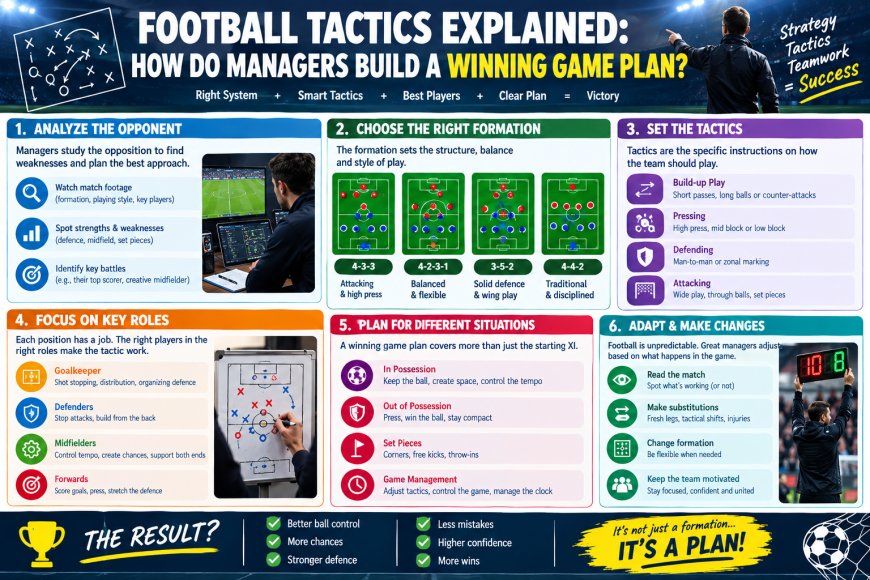
Football is often called a simple game — 22 players chase a ball for 90 minutes — but beneath that simplicity lies one of the most complex tactical landscapes in sport. Every week, managers deploy systems of movement, pressing triggers, passing architectures, and positional structures designed to create chances while denying the opponent theirs. From Pep Guardiola's positional play to Diego Simeone's compact low block, from Jürgen Klopp's gegenpressing to Carlo Ancelotti's adaptive pragmatism, the variety of modern football tactics is vast. Yet the principles behind building a winning game plan are remarkably consistent.
1. Starting With a Philosophy: The Manager's Core Idea
Every game plan begins with a philosophical question: How do we want to play? This is not abstract art — it is a practical framework that determines recruitment, training priorities, and match-day decisions.
Common philosophical poles include:
· Possession-based control: Keeping the ball to dictate tempo, tire opponents, and create high-quality chances through structured build-up (Guardiola, Luis Enrique, Vincent Kompany's developing sides).
· Verticality and transition: Sacrificing possession to strike quickly when the ball is won — prioritising speed, depth, and direct passing (Gegenpressing schools, counter-attacking specialists like Simeone or classic Mourinho teams).
· Positional flexibility: Systems that morph between formations depending on phase — attacking as a 3-2-5, defending as a 4-4-2 (common in modern elite coaching).
· Pragmatic adaptation: Choosing a plan tailored to each opponent rather than a fixed identity (Ancelotti, Zidane's Champions League tenure).
The philosophy must fit the squad. A manager with towering centre-backs and no quick full-backs cannot simply install a high line; one with elite wingers and a static striker will not build purely through central combination play. The first act of tactical construction is honest self-assessment: what are we, and what can we become?
2. Formation: The Skeleton of the System
The formation — expressed as the classic 4-3-3, 4-2-3-1, 3-5-2, 4-4-2, or their variants — is the skeleton upon which everything else hangs. But modern formations are less fixed than the numbers suggest. Analysts increasingly describe systems in terms of structures by phase:
· In possession: Many elite teams attack in a 3-2-5 or 2-3-5 shape — three or two build-up players behind, five attackers across the front line including wingers and advancing full-backs.
· Out of possession: The same team might defend in a 4-4-2 mid-block, with a winger joining the striker to press while the far-side midfielder tucks in.
· Transition moments: The 5–15 seconds after losing or winning the ball, where structure briefly collapses into chaos and trained reactions take over.
Choosing a formation means choosing where you want numerical superiority. Attacking overloads on the flanks suggest wide build-up; a box midfield (two holding players plus two advanced interiors) aims to control the centre; a back three provides stability against wide counters and extra build-up security. Football tactics involve formations, pressing systems, defensive organization, attacking movements, and strategic adjustments that managers use throughout a match. Discover more sports action and updates at Mahadev Book.
Key formation trade-offs include:
· Width vs compactness: Wide systems stretch opponents but leave central spaces; compact systems protect the middle but require wing-back energy.
· Midfield numbers: Three-man midfields control possession better; two-man double pivots free an attacking midfielder but risk being overloaded 3-v-2.
· Defensive security: Back fours are balanced; back threes add cover but demand wing-backs who can both defend one-v-one and provide the entire attacking width.
3. In-Possession Tactics: Building the Attack
Once the skeleton is set, managers design the musculature: how the team creates chances with the ball.
Build-Up Play
Build-up is the first decision chain: goalkeeper to centre-backs to midfielders (or direct to forwards). Managers choose between:
· Playing from the back against pressure — inviting opponents to commit forward so space appears behind their first line. Requires technically secure centre-backs and a goalkeeper comfortable with feet.
· Hybrid build-up — going short initially, then going long to a target if the first wave is squeezed.
· Direct build-up — bypassing midfield pressure with long passes to forwards who lay off or flick on.
The build-up choice dictates everything upstream: goalkeeper recruitment, centre-back passing range, and midfielder positioning (dropping between centre-backs, forming a pivot, or pushing higher between lines).
Positional Play Principles
Popularised by Guardiola's coaching tree, positional play (juego de posición) rests on rules rather than choreography:
1. Create numerical superiority in the zone where the ball is.
2. Avoid fixed positions; occupy zones — players fill spaces, not slots.
3. Limit the number of players on each vertical and horizontal line to preserve depth and width options.
4. Pivot discipline — a fixed reference point (usually a single pivot) connects defence to attack.
5. Third-man combinations — the pass is for the player beyond the receiver; third-man runs unlock packed defences.
Chance Creation Models
Elite teams generate chances through repeatable patterns:
· Half-space overloads: Attacking the channels between centre-back and full-back — the most dangerous zones in modern analysis. Insides wingers, arriving midfielders, and underlapping full-backs all serve this geometry.
· Cut-backs: Byline deliveries pulled back to penalty-spot zones — statistically among the highest-xG chance types.
· Switches of play: Diagonal balls to isolate a winger one-v-one after overloading the opposite side.
· Set pieces: Rehearsed corners, free-kicks, and throw-in routines — a deliberate chance-creation system worth 10–15 goals per season for well-drilled teams.
· Through balls in behind: Timing runs against high lines — the domain of players with pace and vision.
4. Out-of-Possession Tactics: Defensive Architecture
Defence is not merely "everyone behind the ball." Managers design defensive systems with the same precision as attacks.
Defensive Shapes and Blocks
· High press: Defending near the opponent's penalty area, hunting the ball with aggressive triggers (a bad touch, a pass to a weaker-foot centre-back, a backward pass to the goalkeeper). Risky but potentially devastating — regains high up the pitch create immediate chances.
· Mid-block: Defending around the halfway line — the most common shape, balancing risk and reward. Forces opponents into less dangerous areas while preserving energy.
· Low block (deep defence): Packing the penalty area and surrounding zones, conceding territory to deny space behind. The weapon of choice for underdogs against elite possession sides; requires discipline, dense shot-blocking, and quick outlets.
Pressing Triggers and Coordination
Effective pressing is choreographed: the first defender shows a direction, the second cuts the passing lane, the third curbs the switch. Triggers include:
· Poor first touch by the opponent.
· Passes backward or square (slower ball travel).
· The ball travelling to a less comfortable player (weak foot, poor under pressure).
· Set-piece clearances and goal kicks.
Teams invest enormous training time in these moments because pressing without coordination simply opens gaps — the most expensive tactical failure in modern football.
Defensive Transitions
The seconds after losing possession matter enormously. Two broad approaches:
· Counter-press (Gegenpressing): Immediate, collective swarming of the ball for 5–8 seconds — the theory being the most dangerous moment to lose the ball is directly after winning it. Klopp's Liverpool built an era on this principle.
· Rest defence: While attacking, positioning players (often a back three plus pivot) to delay and contain if the ball is lost — designed to prevent quick counters rather than win the ball back instantly.
Elite teams combine both: counter-press when numbers are near the ball; rest-defence structure when the attack has stretched the pitch.
5. Transition Play: The Most Decisive Phase
Research across top leagues consistently finds that a large share of goals originate in transitions — the chaotic switches of possession where structures are least organised. Managers therefore design transition rules:
· Attacking transition: First look = forward. Through ball to running wingers, early crosses, or carrying into space before the defence resets. Speed of thought matters more than formation here.
· Defensive transition: Immediate pressure on the ball plus recovery runs by the far-side players. The goal is to buy 5–10 seconds for the team to re-form its block.
Training-ground transition games — small-sided exercises where possession flips rapidly — are now a staple of elite coaching weeks because these moments decide matches more than settled-possession phases do in many fixtures.
6. Personnel and Role Design
Systems are only as good as the profiles fitting them. Modern role design is specialised:
· Goalkeeper: Shot-stopping plus build-up participation — increasingly an 11th outfielder.
· Centre-backs: Passing range, 1-v-1 defending, aerial ability — and comfort in large spaces if playing a high line.
· Full-backs/wing-backs: The most varied position on the pitch — overlapping engines, inverted midfielders, or hybrid third-centre-backs.
· Holding midfielders: Screen, recycle, and dictate tempo — the "balance" of the team.
· Progressive midfielders: Carriers and line-breakers who turn safe possession into attacks.
· Wingers: Isolation dribblers, goal-scoring forwards inverted onto strong feet, or creative suppliers.
· Strikers: Target references, false nines pressing from the front, poachers occupying centre-backs, or complete forwards linking all phases.
Recruitment analysts match player data (progressive passes, pressures, carry distance, xG, aerial win rates) to the tactical model — the modern marriage of tactics and transfers.
7. Adapting During the Match: In-Game Management
A pre-match plan survives contact with the opponent only partially. Skilled managers adjust through:
· Half-time structural changes: Shifting block height, swapping marking assignments, changing build-up patterns after identifying opponent weaknesses.
· Substitutions as tactical levers: Fresh legs for pressing intensity; a target forward against tiring defenders; an extra midfielder to close a central overload.
· Game-state management: Protecting a lead (deeper block, time control) versus chasing (risk accumulation, set-piece emphasis, numbers forward).
· Opponent-driven reads: Identifying that the opponent's left-back is struggling under pressure and directing switches there repeatedly.
The best in-game managers treat the match as a live experiment — testing hypotheses, reading responses, and iterating faster than the opposition.
8. Set Pieces: The Controlled Chaos
Set pieces deserve special status: they are the only moments where attacking structure is fully rehearsed against a static defence. Analysts now staff dedicated set-piece coaches at elite clubs, designing:
· Delivery zones: Near-post flicks, far-post crowding, penalty-spot routines.
· Blocking and screening: Legal obstruction of markers to free aerial threats.
· Defensive organisation: Zonal-mixed systems, man-oriented markers on key threats, and quick-transition setups after clearances.
· Short routines: Corner variations that catch defences before they set.
Because open-play chances are hard to manufacture against organised defences, set-piece efficiency is one of the clearest tactical edges available to any manager.
9. Data and Video: The Modern Assistant
Contemporary game plans are built with analytical support:
· Opponent analysis: Pressing height data, build-up tendencies, set-piece vulnerability maps.
· Internal metrics: Possession in the final third, field tilt, PPDA (pressing intensity), chance-quality profiles.
· Video sessions: Clip packages showing players their triggers, errors, and repeat patterns.
· Live data: Bench analytics staff relaying heat maps, fatigue indicators, and matchup outcomes during matches (where regulations allow).
Data does not make decisions — managers do — but it sharpens the questions and removes blind spots.
10. Putting It Together: The Anatomy of a Winning Game Plan
A complete tactical plan addresses every phase:
6. Identity: One clear philosophical idea the squad can execute under pressure.
7. Structure: Formation(s) by phase that create desired numerical advantages.
8. Possession plan: Build-up patterns, chance-creation zones, and positional principles.
9. Defensive plan: Block height, pressing triggers, and transition rules.
10. Personnel fit: Roles designed for the actual players available — with contingency profiles for absences.
11. Set pieces: Both boxes, rehearsed weekly.
12. Adaptive toolkit: Pre-planned adjustments for common game states (behind, ahead, vs red cards, vs low blocks).
13. Simplification: Elite coaches distil complexity into a handful of rules players can remember at fatigue's edge — because tactics that cannot survive minute 85 do not exist.